Capturing the Value of Kelp in BC: A Photo Essay
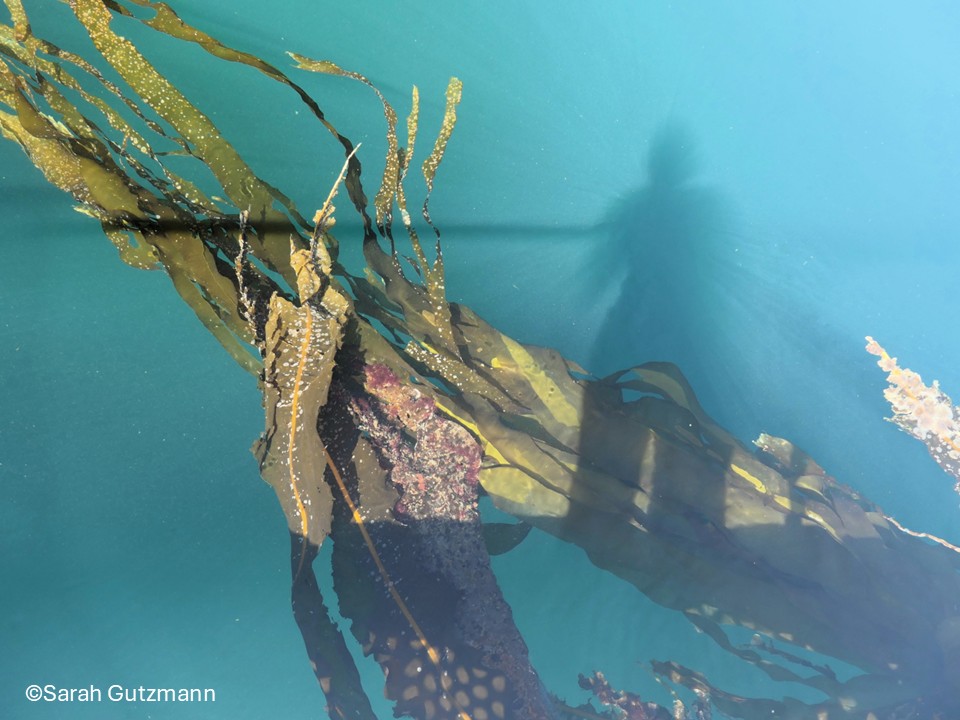
Off the coast of British Columbia, just beneath the surface, entire forests sway in the current. Kelp forests are among the most productive ecosystems on Earth, sheltering fish, feeding coastal communities, and quietly shaping the health of the ocean. Yet most people never see them, rarely think about them, and have no clear language for what they might be worth.
The value of kelp in BC is exactly where my work begins, and it is the question at the heart of a recent project I led with photographer and visual storyteller Ana Lucía Pozas: a photo essay called “Capturing the Value of Kelp in BC.”
Why Pair Kelp Research With Photography
My research is interested in how and why people value kelp. Value is often expressed as a dollar figure, and that number matters, but it leaves so much out. There are intangible factors that money simply cannot represent: a sense of place, a relationship passed down across generations, the feeling of being in or near a living forest. I kept returning to the idea that a spreadsheet was never going to hold all of that.
Photography offered a different medium. Where a report tends to flatten a story into figures and findings, a photo can hold emotion and context at the same time. Photos feel more human. They invite people in rather than asking them to parse a methodology. That is why this became a kelp photo essay rather than only another paper.
Behind the Kelp Photo Essay: A Collaboration
As project lead, I developed the original idea, reached out to the participants, organized the travel, and managed the budget. Ana brought the creative vision. She found ways to represent what people shared with us in an engaging and honest way, and she captured and edited the images. From there we worked together to select the final set and shape the story they told.
I want to be clear about whose images these are. Rather than re-hosting Ana’s photographs here, I would encourage you to view the essay where it lives, on her site. You can see the full kelp photo essay on Ana Lucía Pozas’s website. The images speak far better than any summary of them could.

Four Lessons From BC's Kelp Forests
The essay distills what we learned into four lessons. Kelp as foundational, holding ecosystems and food systems together. Kelp as facilitator, enabling livelihoods and gatherings. Kelp as a medium for connection, between people, place, and culture. And kelp as a role model for adaptability.
It was that last lesson that surprised me most, or perhaps stood out to me the most. We ended up centering the whole story around it, framing kelp not just as a resource to be measured but as a teacher. Kelp forests have been stewarded by coastal and Indigenous communities for food, for materials, and as a cultural relation for millennia. There is something to learn from a forest that has persisted, adapted, and remained in relationship with people for that long. Letting kelp be the teacher, rather than only the subject, changed how the essay feels.
Capturing the Value of Kelp in BC: A Photo Essay
Off the coast of British Columbia, just beneath the surface, entire forests sway in the current. Kelp forests are among...

Regenerating Ourselves While Regenerating the Environment: What I Learned from the Regenerative Practitioner Series
I’ve loved the natural world for as long as I can remember. As a kid, I spent my days outside,...
Why Kelp Matters in British Columbia
If I had one sentence for someone who has never thought about kelp, it would be this: kelps, a type of large brown macroalgae or seaweed, form undersea forests around the world, they have been cared for by people for thousands of years, and today they appear in medicine, cosmetics, fertilizers, biotechnology, and as food for both people and livestock.
That breadth is part of what makes kelp so compelling, and it is also why kelp cultivation, kelp restoration, and the ecosystem services these forests provide draw so much interest along the BC coast. Kelp supports marine conservation goals while offering real economic potential, which is a rare and valuable combination.
Kelp Aquaculture and the Blue Economy
That combination also points to the biggest misconception I encountered. People tend to assume that because kelp is important to communities and important to the environment, anything we build around it, including kelp aquaculture and farming, must automatically be good for both. That does not follow. The fact that kelp matters does not guarantee that a kelp economy will be regenerative or fair.
We need systems in place to make sure kelp economies are genuinely “Blue,” in the sense of the Blue Economy, and that they give back as much as they take. Holding those two truths at once, that kelp is valuable and that its economy still has to be designed with care, is some of the most important work ahead.
A Moment Underwater
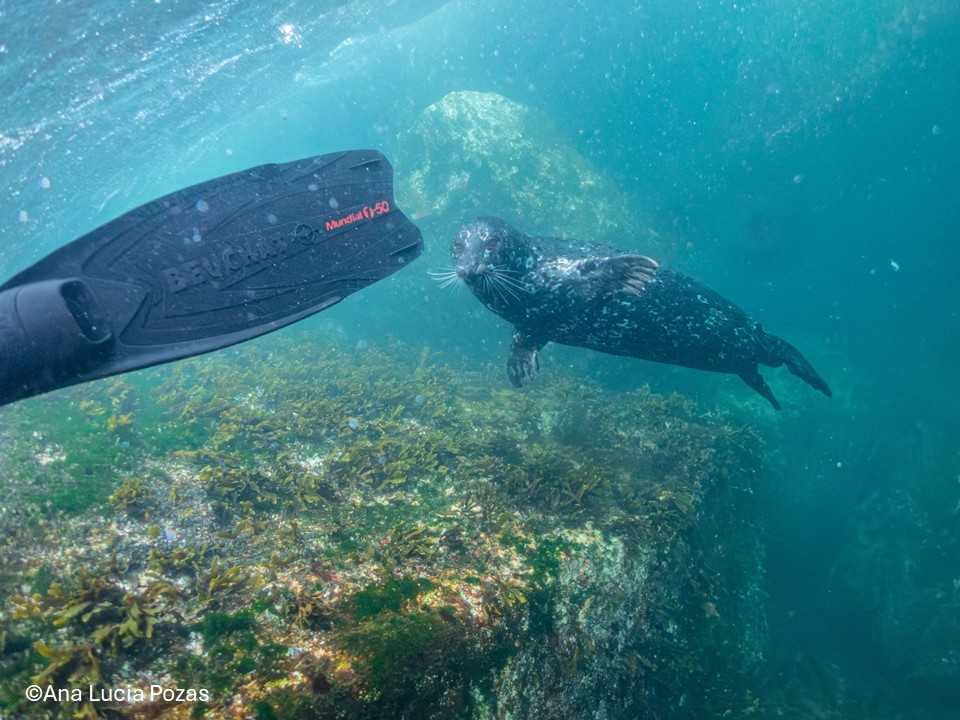
Not everything about the project happened on a spreadsheet. During the free-diving shoot, a curious harbour seal joined us for a while and decided our fins were worth investigating. It tried to chew on them. It was, simply, pretty magical, and a small reminder of why this place is worth paying attention to in the first place.
What I Hope You Take Away
My hope for this essay is modest and specific. I would love for you to view it, sit with the images, and let the questions it raises stay with you for a while. I am less interested in what I have to say about kelp than in what you find yourself thinking about once you have seen it. If the essay does its job, the lasting impression will be yours rather than mine.
This project will also be accompanied by an academic article, though I do not have a timeline to share just yet. When it is ready, it will appear among my research and publications.
Credits and Support
This work was supported by the Ocean Wise Ocean Action Grant, in association with Simon Fraser University and the Ocean Nexus network, through the Ocean Equity Lab. You can learn more about the grant program through Ocean Wise. Full credits for the photography live on Ana’s page, and I am grateful for her vision and for everyone who shared their relationship with kelp so openly.
The forests are out there, swaying in the current. The question of what they are worth, and to whom, is one worth sitting with.